Frameless Sliding Glass Shower Doors in Phoenix, AZ: The Complete Homeowner’s Guide
Costs, glass thickness, hardware, and installation for single- and double-sliding frameless glass from a Phoenix shop cutting glass since 1972.
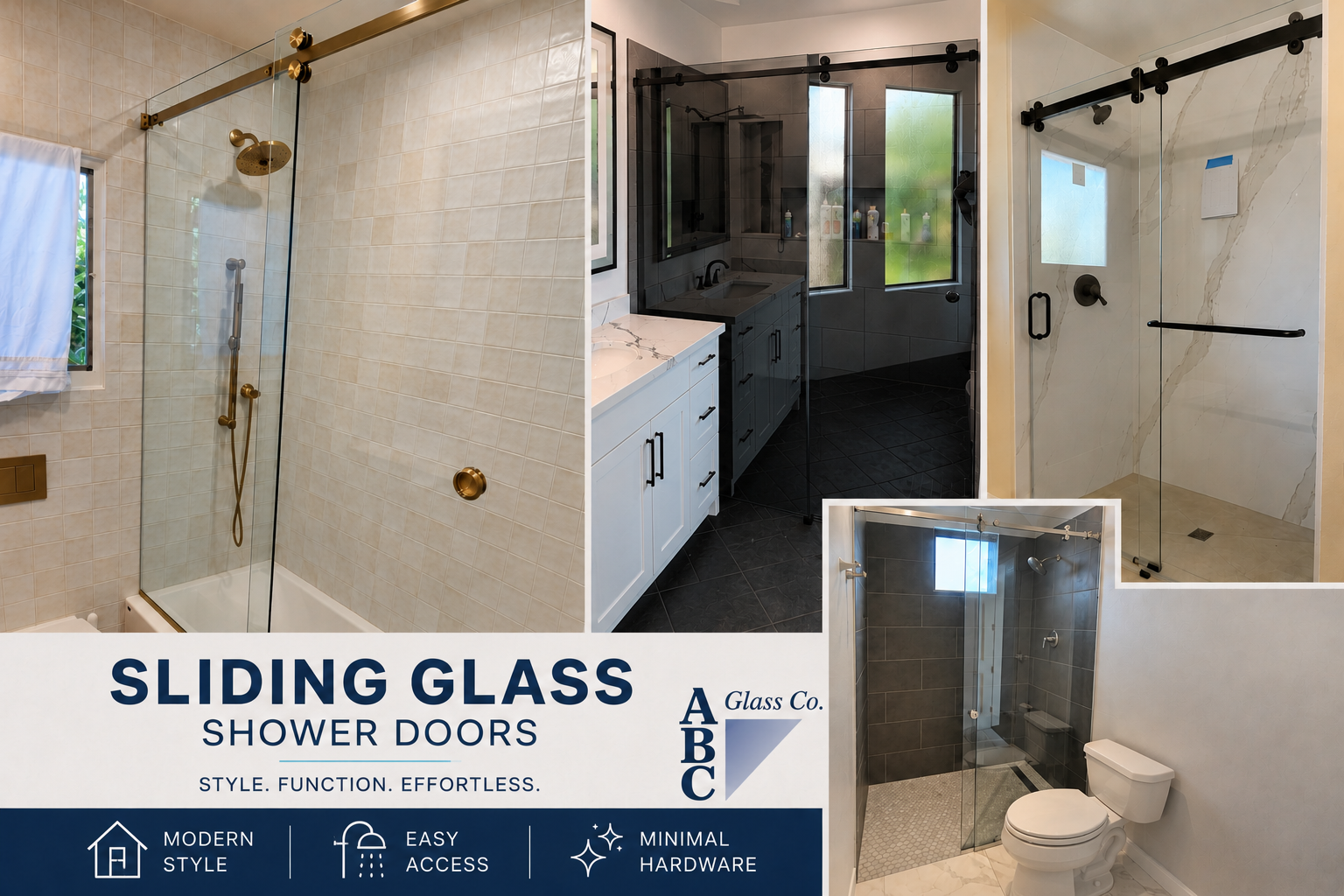
Quick answer: A frameless sliding glass shower door uses thick tempered glass panels that ride on an exposed roller system or a slim overhead header, with no metal frame surrounding the glass. In Phoenix, most installed projects range from $1,500 to $4,500, depending on glass thickness, hardware finish, and opening size. ABC Glass Company has fabricated and installed custom shower glass from the same Cave Creek Road shop since 1972.
If you have a standard alcove shower or a tub surround in a Phoenix home, you have probably run into the same problem every homeowner in the Valley eventually faces. You want the clean, open look of frameless glass, but you do not have the floor clearance for an outward-swinging door. That is exactly the gap that frameless sliding glass shower doors fill. They give you the same heavy glass and minimal hardware you would get with frameless shower enclosures in Phoenix, but the panel glides sideways rather than swinging into your vanity.
This guide walks through how these systems actually work, what they cost in the Phoenix market, which glass and hardware options hold up best in Arizona water, and what a proper installation looks like. It is written from the perspective of a shop that cuts and installs this glass every week, not from a catalog.
What Is a Frameless Sliding Glass Shower Door?
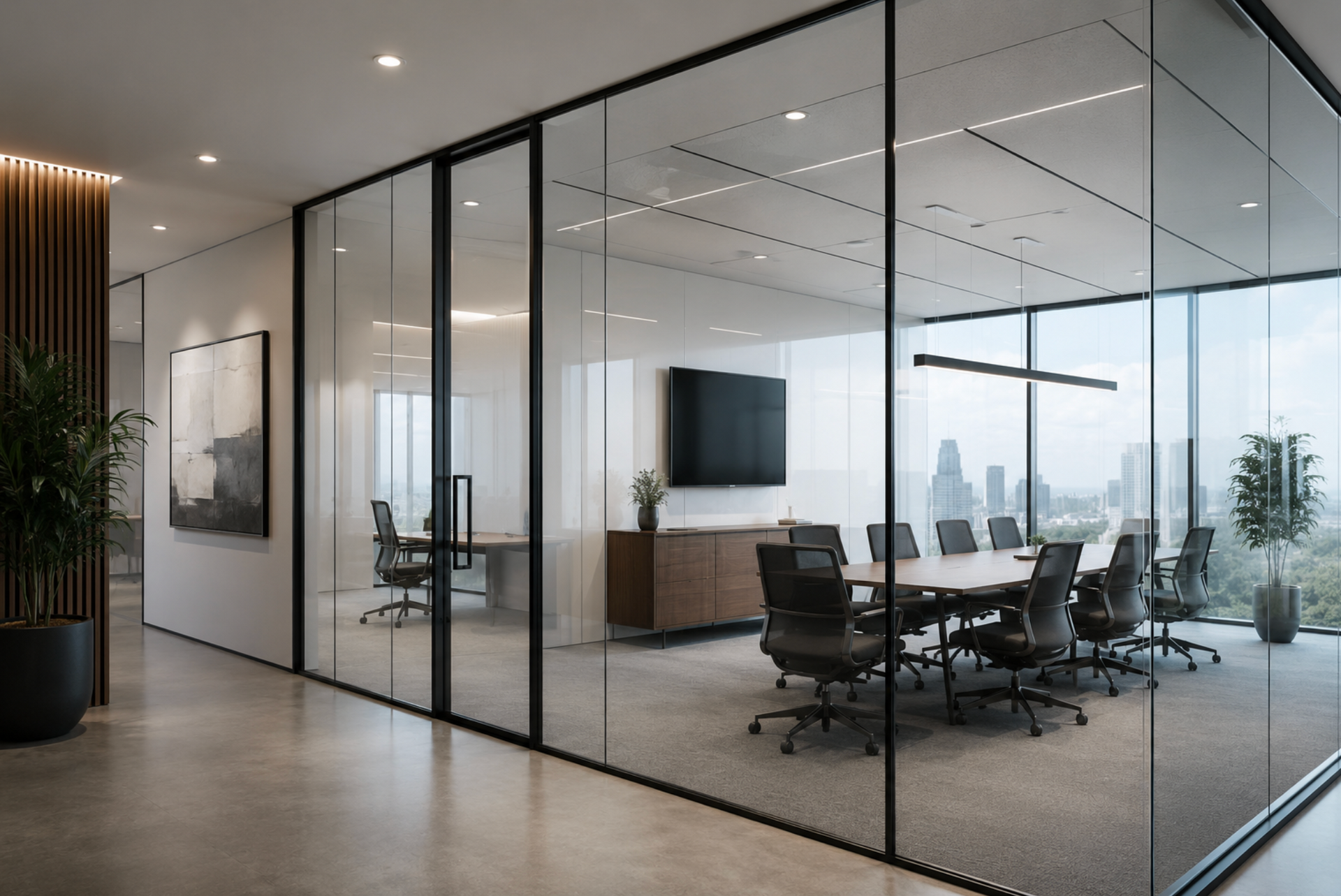
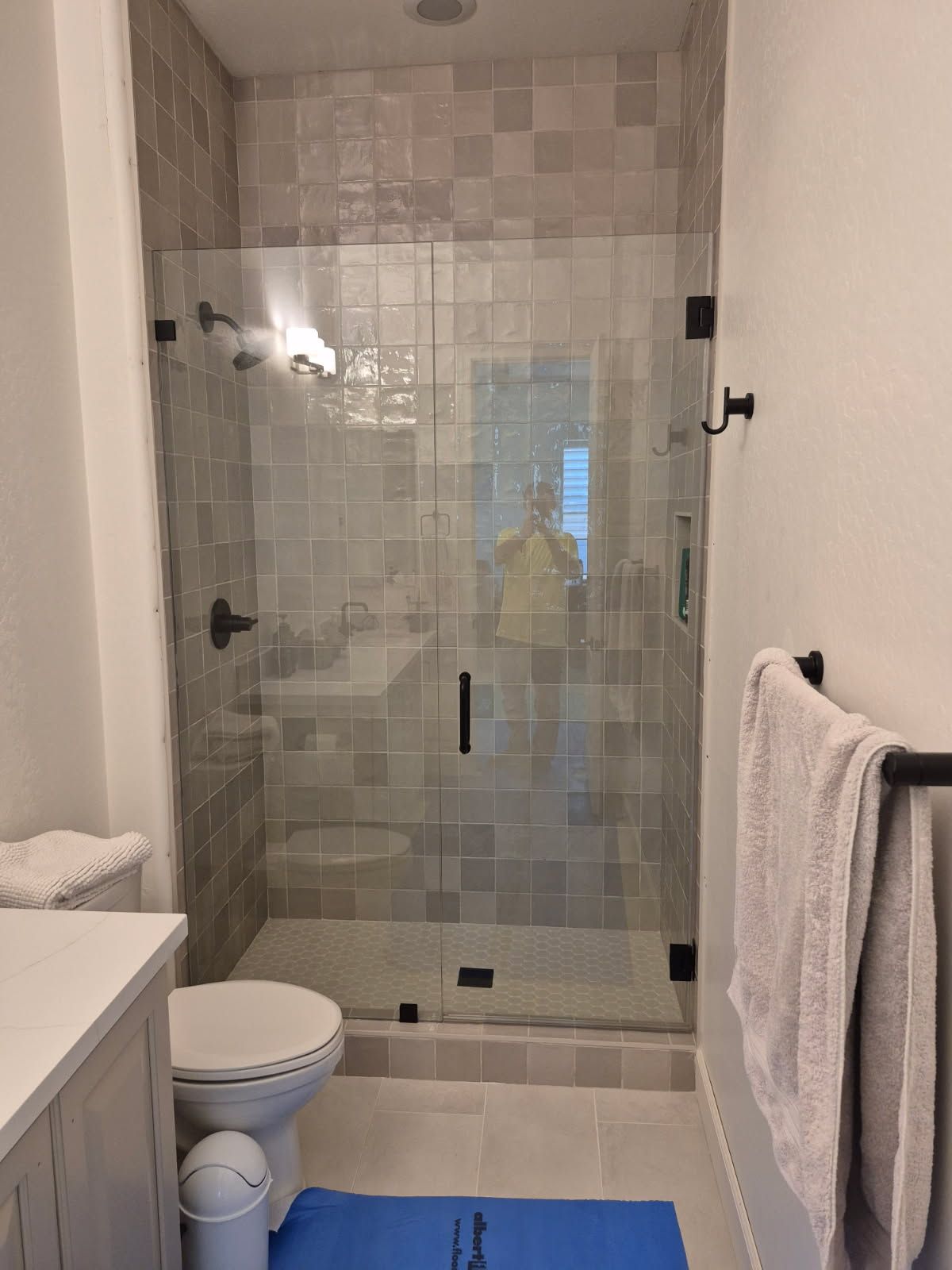
A frameless sliding glass shower door is a shower enclosure made of tempered safety glass panels that slide horizontally along a track, header, or exposed roller bar, with no aluminum frame wrapped around the perimeter of the glass. Panels are typically 3/8-inch or 1/2-inch thick. Because the glass carries its own weight, hardware is limited to rollers, wall brackets, a bottom guide, and a handle.
The category goes by several names depending on who you are talking to. Homeowners search for sliding glass shower doors. Designers call them bypass enclosures. Installers often say barn door showers when the hardware uses an exposed wheel riding on a rail. All of them describe the same basic idea: one fixed panel and one moving panel, or, in a double-sliding configuration, two moving panels that pass each other.
Frameless, Semi-Frameless, and Framed Sliding Doors
The three styles are not interchangeable, and the difference is not just cosmetic. It affects glass thickness, hardware load, water containment, and price.
- Framed sliding doors. Built with 1/4 inch tempered glass, with aluminum surrounding every glass edge and the track. Expect roughly $800 to $2,000 installed in Phoenix.
- Semi-frameless sliding doors. Use 1/4 to 3/8-inch tempered glass with framing only along the perimeter, leaving the door edges exposed. Expect roughly $1,200 to $2,800 in installation costs.
- Frameless sliding doors. Use 3/8 to 1/2 inch tempered glass with no perimeter frame at all, just a slim header or exposed rollers. Expect roughly $1,500 to $4,500, plus installation.
Framed doors are the most watertight and the least expensive because the aluminum channel does the sealing for you. Frameless doors move that responsibility to precise measurement, correct curb pitch, and properly specified sweeps and seals. That is the trade you are making when you choose frameless. You get a dramatically cleaner look, and in exchange the installation has to be right.
Single Slider vs. Double Sliding Glass Shower Doors
A single slider pairs one fixed panel with one moving panel. It is the most common configuration in Phoenix alcove showers and tub surrounds, and it is usually the most affordable frameless sliding option.
Double sliding glass shower doors use two moving panels that slide past each other, giving you entry points on either side of the opening. This is the better choice for wide openings, for showers with a bench or niche on one end, and for households where accessibility matters. It costs more because you are buying more glass and a longer header, but for openings over about 60 inches wide, it is often the only configuration that operates comfortably.
If you are still deciding between layouts, it helps to see the configurations side by side. You can design your shower layout online before you ever schedule a measurement.
Why Sliding Doors Make Sense in Phoenix Bathrooms
Sliding shower doors are the practical choice in Phoenix homes with alcove showers, tub-to-shower conversions, and compact secondary bathrooms, because the panel never needs swing clearance. Homes built across North Phoenix, Moon Valley, and the Arcadia corridor frequently have 60-inch tub openings with a vanity directly opposite, which rules out a hinged frameless door entirely.
Valley housing stock creates a specific set of bathroom problems. A large share of homes built from the 1960s through the early 2000s use a standard 60-inch alcove tub with limited floor space in front of it. Master bathrooms in newer Desert Ridge and Anthem builds are more generous, but secondary and guest bathrooms almost always are not.
Here is where a sliding configuration solves problems that a swing door cannot:
- The door never swings into a vanity, toilet, or towel bar
- Water on the door face stays inside the enclosure instead of dripping onto the floor when it opens
- Tub-to-shower conversions work without rebuilding the surrounding walls
- Wide openings stay fully usable, since the opening is split rather than blocked
- Wheelchair and mobility access improves with a double sliding layout that opens from either side
We install these throughout Phoenix and across the surrounding communities we cover, including Scottsdale, Paradise Valley, Cave Creek, Carefree, Anthem, Glendale, Peoria, and Fountain Hills. The layout problems repeat from one neighborhood to the next, and so do the solutions.
The Arizona Hard Water Factor
This is the part most national shower door guides get wrong for our market. Phoenix municipal water is among the hardest in the United States. City of Phoenix water quality sampling has consistently reported hardness in the range of roughly 10 to 16 grains per gallon, and the metro average sits well above the national norm.
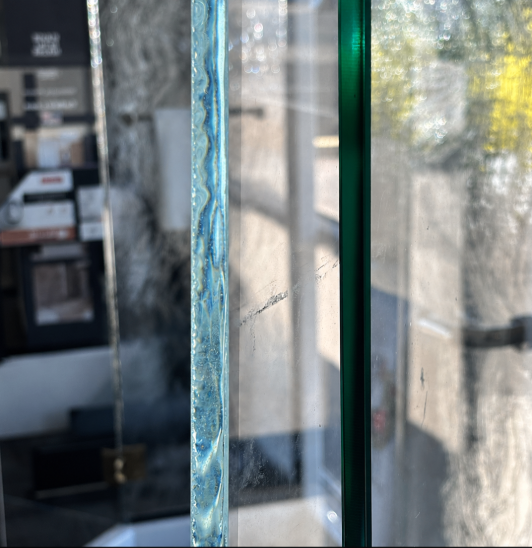
What that means for shower glass is simple. Untreated mineral deposits do not just sit on the surface. Over months, calcium and silica bond to the glass and begin to etch it. Once etching starts, no cleaner reverses it, and the only real fix is replacement glass. That is why every conversation we have about custom frameless shower door installation in the Valley includes a conversation about protective coatings and squeegee habits. It is not an upsell. It is the difference between glass that looks new in year seven and glass that looks cloudy in year two.
Glass Options for Frameless Sliding Shower Doors
Frameless sliding shower doors use 3/8-inch or 1/2-inch tempered safety glass. Tempered glass is required by CPSC 16 CFR 1201 and ANSI Z97.1 for shower enclosures because it breaks into small, blunt pieces rather than shards. Common upgrades include Starphire low-iron glass for clarity, frosted or textured glass for privacy, and a factory-applied protective coating for hard-water resistance.
Glass Thickness
Thickness is a structural decision, not a style decision. On a sliding system, the moving panel hangs from rollers, so the glass must support its own weight without flexing.
- 1/4 inch tempered. Suitable only for framed and semi-frameless sliders, where the frame carries the load. It is light, flexes noticeably, and is the lowest-cost option.
- 3/8 inch tempered. The standard for most frameless sliding doors across the Valley. Solid, quiet on the rollers, and moderately priced.
- 1/2 inch tempered. Reserved for wide or tall panels and double sliding layouts. It is the heaviest and most rigid option, with the most substantial feel and the highest cost.
For most Phoenix showers, 3/8 inch is the right answer. It is rigid enough to run smoothly on rollers for decades, and it does not require oversized hardware. We recommend 1/2-inch when a panel exceeds roughly 36 inches wide, when ceiling height pushes the glass above standard, or when a client simply wants the heavier feel of a luxury enclosure.
Clear, Low Iron, and Privacy Glass
- Clear tempered glass. The default, and the most affordable option. It carries a faint green tint at the edges, caused by the iron content in standard float glass. Most people never notice it.
- Starphire low-iron glass. The iron is reduced during manufacturing, so the glass reads truly colorless. On a large sliding panel, the difference is obvious, particularly against white marble or light tile. It typically adds 15 to 25 percent to the cost of glass.
- Frosted and acid-etched glass. Obscures the view while still allowing light to pass. A practical choice for shared or guest bathrooms.
- Rain, reeded, and patterned glass. Textured options that add privacy and a design element at the same time. Reeded glass in particular has become a common request in Scottsdale and Paradise Valley remodels.
- Protective coating. A hydrophobic treatment bonded to the glass surface that makes mineral deposits far easier to wipe away. In a market for our water, this is the highest-value upgrade on the list.
We walk clients through all these frameless shower glass options for Phoenix homes, using physical samples in the shop, because photographs of textured glass are almost useless. You need to hold it up to the light.
Hardware: What Actually Determines How the Door Feels
Sliding shower door hardware includes the header or rail, the roller assembly, wall mount brackets, a bottom guide, seals and sweeps, and the handle or towel bar. Roller quality is the single largest factor in how the door operates over time. Sealed bearing rollers glide quietly for years, while inexpensive open rollers collect mineral scale and begin to bind.
Homeowners tend to focus on finish and overlook the mechanics. In practice, the mechanics are what you will notice every single day.
Roller and Header Systems
Barn-style systems mount an exposed wheel that rides on a horizontal rail, giving you a visible industrial look. Concealed header systems hide the rollers inside a slim tube at the top of the enclosure for a cleaner line. Both work well. The barn style tends to read more contemporary, while the concealed header disappears visually.
We source hardware from suppliers with a track record in this climate, including Shower Hardware Supply and the Arizona Shower Door product lines, as well as heavy glass fabrication from Hartung and PRL. Naming those relationships is not name-dropping. Hardware sourced from a local supplier means replacement parts are available in years eight and twelve, which matters more than the price difference on day one.
Finishes
Finish selection should follow your plumbing fixtures, not the other way around. Current requests in the Phoenix market skew toward:
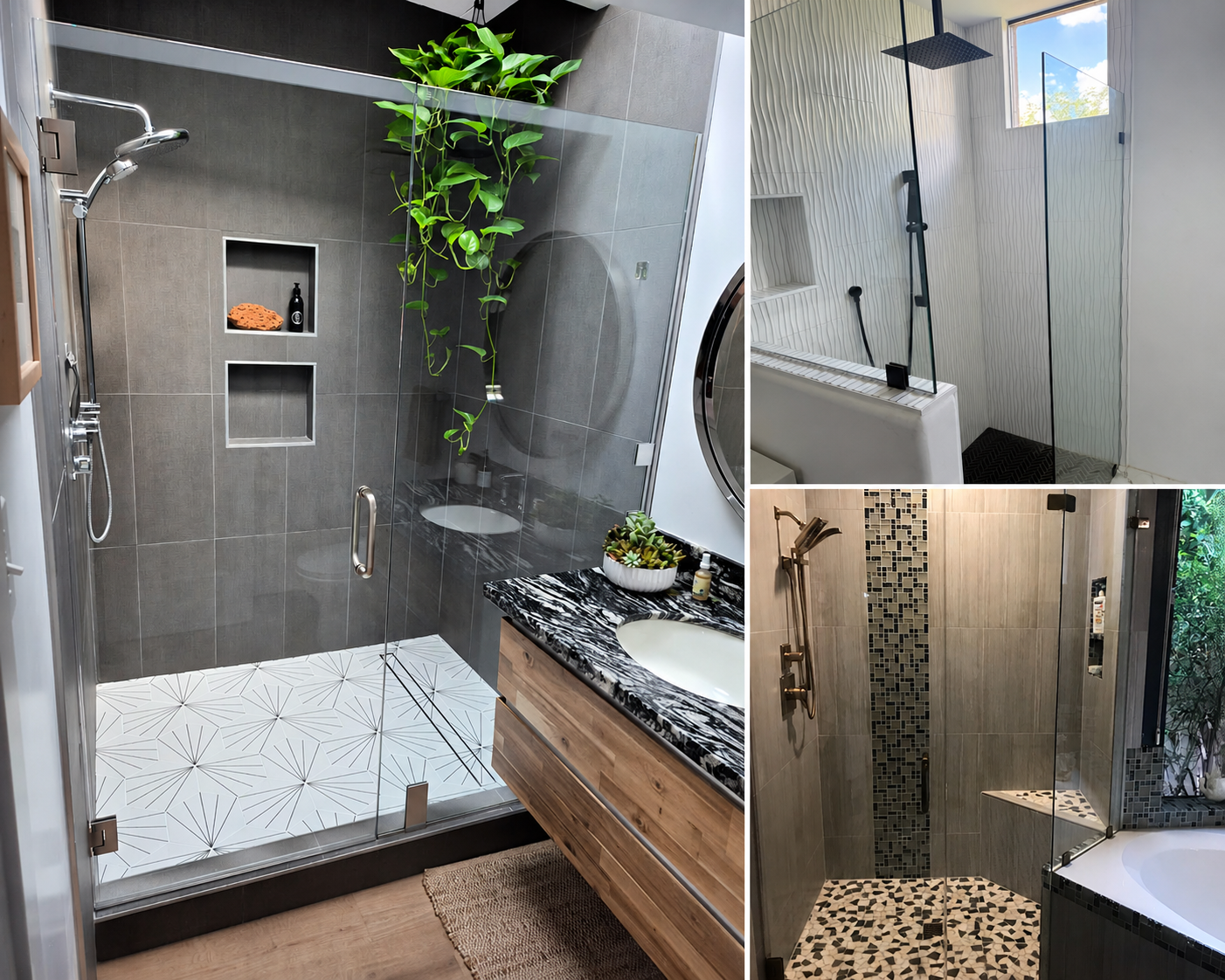
- Matte black, still the most requested finish for contemporary remodels
- Brushed nickel, the safest long-term choice and the easiest to match
- Polished chrome, classic and the most forgiving on water spots
- Satin brass and champagne bronze, warm finishes trending strongly in higher-end builds
- Oil rubbed bronze, best suited to traditional and Southwestern interiors
Seals, Sweeps, and Why Frameless Sliders Do Not Have To Leak
The most common question we field about frameless sliding doors is whether they leak. A correctly built one does not. Water containment on a frameless slider comes from four things working together: a shower curb or threshold pitched slightly inward, a clear polycarbonate sweep along the bottom of the moving panel, a jamb seal where the fixed panel meets the wall, and correct panel overlap at the center.
When a frameless slider leaks, it is almost always due to one of three causes. The curb was tiled flat or sloped outward. The showerhead sprays directly into the center seam. Or the panels were cut from a single measurement instead of measured at multiple points on walls that are not plumb. Phoenix homes settle, and very few shower walls in a house built in 1978 are actually square. That is why we measure at three heights on every opening.
Frameless Sliding Glass Shower Door Cost in Phoenix
Frameless sliding glass shower doors in Phoenix typically cost $1,500 to $4,500 installed. A standard single slider for a 60-inch tub opening with 3/8-inch clear glass usually ranges from $1,800 to $2,600. Double sliding glass shower doors, low-iron glass, and premium finishes push projects toward the upper end. ABC Glass Company provides free on-site measurements before any quote is issued.
Pricing is driven by a short list of variables:
- Opening width. The largest single driver. Every added inch means more glass and a longer header.
- Glass thickness. A 1/2-inch panel typically runs 25 to 40 percent above the same panel in 3/8-inch.
- Single vs. double slider. A second moving panel adds both glass and hardware, so bypass layouts always cost more.
- Low iron glass. Starphire and similar low-iron products usually cost 15 to 25 percent more than standard clear.
- Textured or patterned glass. Pricing varies widely depending on which patterns are currently available.
- Hardware finish. Specialty finishes such as satin brass cost more than polished chrome or brushed nickel.
- Protective coating. A small line item with a large long-term return given Phoenix water.
- Notching and custom work. Benches, niches, and return panels all require additional fabrication.
One note on comparison shopping. A big-box store quote for a sliding door usually refers to a boxed, standard-sized, semi-frameless unit. That is a legitimate product, and it has its place, but it is not the same as a custom-fabricated, frameless enclosure cut to your actual opening. If a quote seems dramatically lower, check the glass thickness and confirm whether the panels are custom cut. For a full breakdown of frameless shower door pricing in Phoenix, we publish ranges rather than hiding behind a call for pricing.
What the Installation Process Looks Like
A professional sliding shower door installation is not a same-day, off-the-shelf job. Every panel is fabricated for your opening. Here is the sequence we follow on every residential project.
- Consultation. We discuss layout, glass, hardware, and budget, and talk through how the bathroom actually gets used day to day.
- On-site measurement. A technician measures the opening at multiple heights, checks the walls for plumb, and confirms the curb pitch. This visit is free.
- Fabrication. The glass is cut, edges are polished, holes are drilled for hardware, and the panels are tempered. Nothing is drilled after tempering, which is why measurements have to be exact.
- Installation. Brackets and the header are anchored to studs or blocking; the fixed panel is set; the moving panel is hung and adjusted; and seals and sweeps are fitted.
- Sealing and cure. Silicone is applied where required and takes roughly 24 hours to fully cure before the shower is used.
- Final walkthrough. We check operation, alignment, and water containment with you before we leave.
From the measurement visit to installation day, most frameless sliding projects take about 1 to 3 weeks, depending on glass availability and whether the order includes low-iron or specialty-patterned glass. Installation day itself typically takes three to five hours for a standard single slider.
How to Choose a Sliding Shower Door Contractor in Phoenix
The glass and hardware are largely commodities. What separates one installation from another is measurement discipline, fabrication quality, and whether the company will still be around when a roller needs replacing in year ten.
Questions worth asking any glass contractor before you sign:
- Are you licensed and bonded in Arizona, and what is your ROC number?
- Do you fabricate glass in-house or subcontract it?
- What glass thickness are you quoting, and is the panel custom cut to my opening?
- How do you handle walls that are out of plumb?
- What does the workmanship warranty cover, and for how long?
- Can I see the hardware and glass samples in person before ordering?
ABC Glass Company has operated from the same location on Cave Creek Road in Phoenix since 1972, and we hold Arizona ROC license #161673-K65. We cut and polish glass in our own shop, which is increasingly uncommon in this market. Several of our team members have been at this shop for more than twenty years. Our work across the Valley, including our expanded residential glass and historic window services, was recently featured in an industry press article about ABC Glass Company.
Every installation is backed by our workmanship warranty, and every quote starts with a free on-site measurement rather than a phone estimate.
Ready to Upgrade Your Shower?
If you are tired of a rattling framed door, a mildewed curtain, or a shower that just looks dated, a frameless sliding glass enclosure is one of the highest impact bathroom upgrades available. It changes how the entire room reads, and it does it in a single day of installation.
Our team will come to your home, take precise measurements, show you glass and hardware samples, and provide a clear written quote with no pressure. There is no charge for the measurement and no obligation to move forward.
Get started today. Call ABC Glass Company at (602) 782-5007 or request a free shower door estimate online. We serve Phoenix, Scottsdale, Paradise Valley, Cave Creek, Carefree, Anthem, Glendale, Peoria, and Fountain Hills, and we have been doing it from the same Phoenix shop since 1972.
Frequently Asked Questions About Frameless Sliding Glass Shower Doors
What is a frameless sliding glass shower door?
A frameless sliding glass shower door is an enclosure built from thick tempered glass panels that slide horizontally on rollers or a slim header, with no metal frame around the glass. Panels are usually 3/8-inch or 1/2-inch thick and custom-cut to your opening. ABC Glass Company installs custom frameless shower enclosures throughout Phoenix with panels fabricated in our own shop.
Frameless shower doors offer a sleek, modern look with minimal hardware and generally range from $1,500 to $4,500+, with larger custom enclosures and premium glass options such as Starphire® low-iron glass costing more.
Do frameless sliding shower doors leak?
A properly installed frameless sliding door does not leak. Water containment comes from a curb pitched slightly inward, a clear sweep on the bottom of the moving panel, jamb seals at the wall, and correct panel overlap at the center. Leaks almost always trace back to a flat or outward sloping curb, a showerhead aimed at the center seam, or panels cut from a single measurement on walls that are not plumb.
How much do frameless sliding glass shower doors cost in Phoenix?
Most frameless sliding glass shower doors in Phoenix cost between $1,500 and $4,500 installed. A standard single slider for a 60-inch opening with 3/8-inch clear glass generally ranges from $1,800 to $2,600. Double-sliding panels, low-iron glass, and specialty finishes push the total higher. See current frameless shower door options and pricing in Phoenix for details.
What is the difference between a bypass door and a single sliding shower door?
A single sliding door pairs one fixed panel with one moving panel, so the shower opens from one side only. A bypass, or double sliding, configuration uses two moving panels that pass each other, giving you entry from either side. Bypass layouts cost more because they use more glass, but they operate far better on openings wider than about 60 inches.
Are sliding shower doors better than hinged doors for small bathrooms?
Yes, in most cases. A hinged frameless door needs roughly 24 to 30 inches of unobstructed swing clearance, which many Phoenix guest bathrooms simply do not have. A sliding panel needs zero clearance because it travels along the opening. If your vanity or toilet sits directly across from the shower, a sliding frameless option is usually the only workable option. Compare frameless shower door configurations for your bathroom before deciding.
Can a sliding glass shower door be installed over a bathtub?
Yes. Tub enclosures are one of the most common applications for frameless sliding glass. The header mounts to the tub deck and side walls, and the panels are cut to your tub opening. This is also the standard approach for tub-to-shower conversions in Phoenix homes with a 60-inch alcove, since it avoids rebuilding the surrounding walls.
How long does frameless sliding shower door installation take?
Installation day usually takes three to five hours for a standard single slider, and longer for double sliders or custom-notched layouts. The full timeline from measurement to installation is about 1 to 3 weeks while the glass is fabricated and tempered. Silicone needs roughly 24 hours to cure before the shower is used. Learn more about our frameless shower installation process in Phoenix.
Do frameless sliding glass shower doors add value to a home?
They do. Bathroom updates consistently rank among the strongest returning home improvements, and frameless glass is one of the most visible changes you can make in a bathroom for a comparatively modest cost. In Scottsdale and Paradise Valley listings in particular, frameless shower glass has become an expected feature rather than an upgrade.
Ready to get a quote?
Yes, and it is free. ABC Glass Company provides no-cost, no-obligation on-site measurements and written estimates for frameless sliding glass shower doors throughout the Phoenix metro area. Call us at (602) 782-5007 or contact ABC Glass Company for a free estimate, and we will get you scheduled.
The ABC's Of Glass

About the Author – Taylor Ann Hancock
Taylor Ann Hancock is the founder of Glass Mama Marketing and a dedicated advocate for innovation within the glass industry. She stays at the forefront of search engine, AI, and digital marketing trends to ensure the information she publishes is accurate, relevant, and aligned with the latest industry developments. Through ongoing research and collaboration with glass professionals nationwide, Taylor provides trustworthy insights that help readers make informed decisions about glass products, services, and industry best practices.