The Snowbirds Are Back: Frameless Shower Enclosures for Arizona's Fall Remodel Season
What returning Phoenix-area homeowners should consider when planning a bathroom renovation after the summer heat.
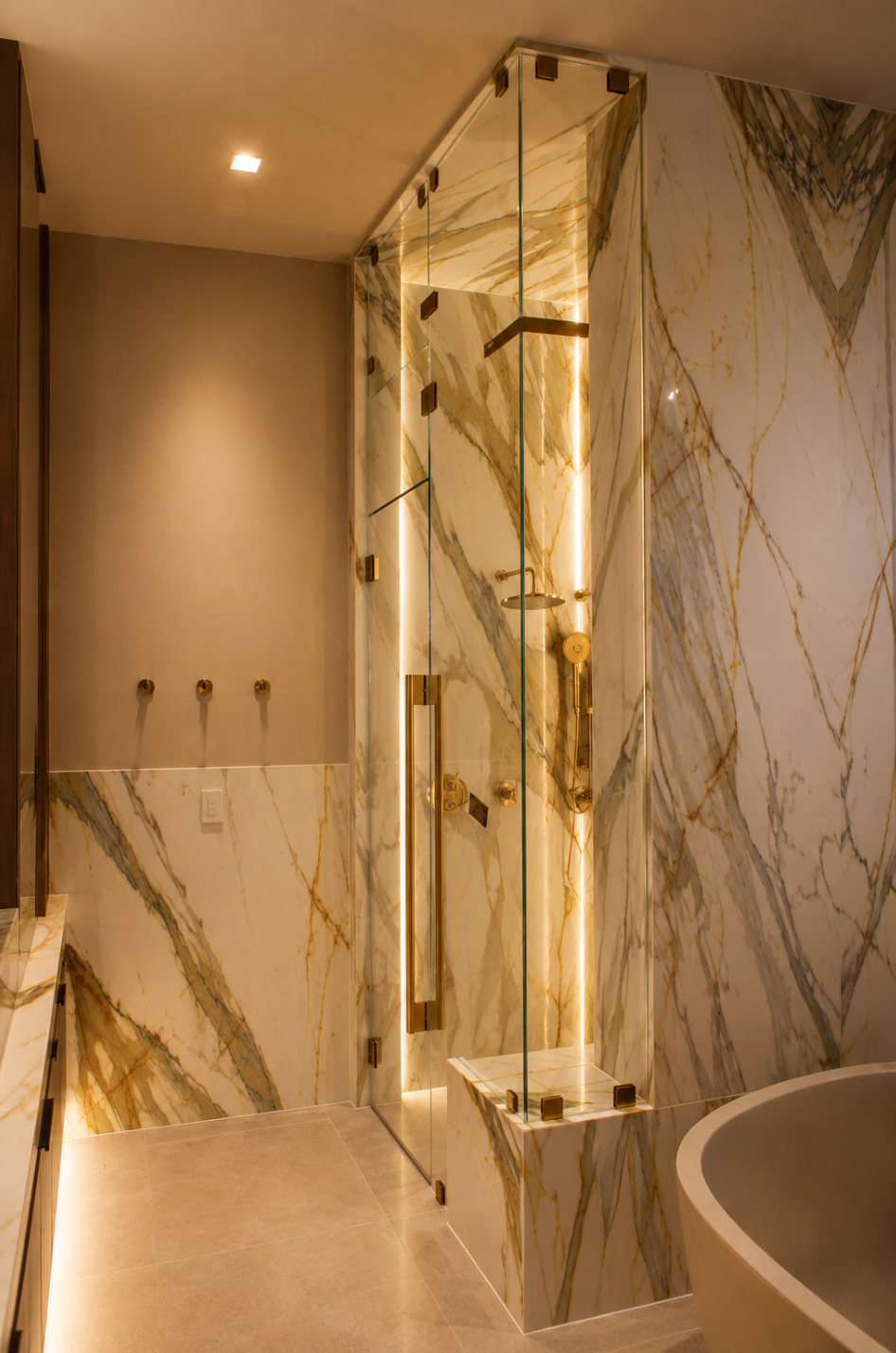
If you are reopening an Arizona home this month and a bathroom project is finally moving up your list, the calendar matters as much as the design. Frameless shower enclosures are custom-fabricated to measurements taken in your finished bathroom, and ABC Glass Company says fabrication typically takes one to three weeks after those measurements. For a seasonal resident with a departure date, that lead time shapes every other decision.
This article is written for the homeowner who has been away since spring, walked back into the house in September, and started noticing things.
Why a House You Have Been Away From Looks Different in September
Coming back after four or five months resets your eye. For a few days you see the house the way a guest sees it, before familiarity takes over again.
That window is short, and it is why so many Valley bathroom projects get decided in the fall. In April you are packing and thinking about the drive. In September you are unpacking into a house that sat closed and quiet through the hottest stretch of the year, and finishes you had stopped registering are suddenly the first things you look at.
The primary shower is usually where it starts. It is a small room with hard surfaces and good light, and nothing in it is hidden.
What Sitting Unused Through an Arizona Summer Does to an Old Enclosure
A shower that goes several months without use in a closed-up Valley home tends to come back worse than you left it. A few conditions show up repeatedly in Phoenix, Scottsdale, Paradise Valley, Cave Creek, and Carefree homes that shut down for the summer.
- Hard water deposits set hard. Valley water carries a heavy mineral load, and whatever was on the glass in April had months of dry heat working on it. Spotting that used to wipe off can take a dedicated descaler by September.
- Framed enclosures age at the metal. Aluminum track and channel collect mineral scale and soap residue in seams a sponge cannot reach. After a long idle stretch, that discoloration and corrosion is easier to see and much harder to clean out.
- Old silicone gives up. Sealant that was already brittle in the spring is often cracked or lifted at the curb and corners by the time you return.
- Dry traps and standing odor. That is a plumbing issue rather than a glass one. It is also frequently the reason you walk into the bathroom in the first place, and once you are standing there, you start looking around.
None of this means an old enclosure has failed. It means the fall is when you finally see it.
The Difference You Stop Noticing When You Live With It Daily
Framed and semi-frameless enclosures are built around metal. The frame carries the structural load, which is why the glass can be thinner, and it is also why those units collect grime in places nobody can properly clean.
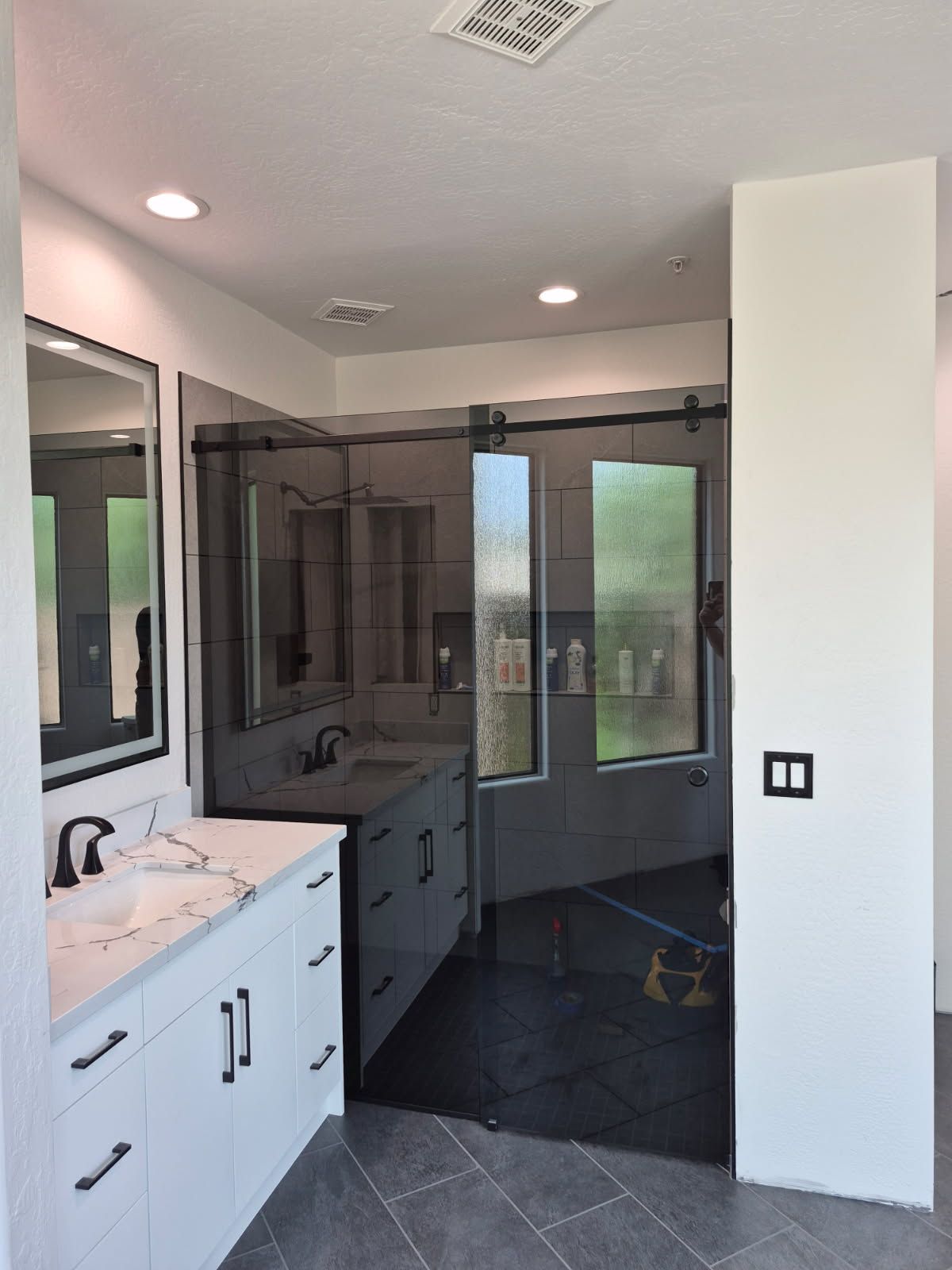
Frameless shower enclosures move that structure into the glass itself. ABC Glass Company builds custom frameless shower enclosures from 3/8-inch and 1/2-inch tempered safety glass, held by wall-mounted hardware instead of a perimeter frame. Fewer channels mean fewer places for scale to accumulate. It also means the tile work you paid for stays visible rather than being interrupted by aluminum every few feet.
That is a maintenance and sightline point, not a style point. Style is covered everywhere. Maintenance is what returning homeowners tend to raise after seeing what four months of vacancy did to a framed unit.
Why the Primary Bathroom Rises to the Top of the Fall Project List
The primary bathroom competes well against other fall projects because it is a contained scope with a hard finish line.
Compare it to a kitchen. A kitchen remodel takes over the house, tends to run long, and is difficult to live through when you have a fixed departure date in the spring. A bathroom project has a defined footprint and a door you can close. If the house has a second full bath, daily life continues while the work happens.
Seasonal owners feel this more than year-round owners do. You spend fewer total days in this house than a full-time resident spends in theirs, and the shower is part of every single one of those days. The room takes up a large share of your actual time in Arizona and usually a small share of the remodel budget.
If the bathroom already has sound tile and a sound pan, the enclosure may be the entire project. A gut renovation is not always required to change how the room reads. Replacing a dated framed unit with a custom frameless enclosure is often a single-trade job, and it can be scoped, measured, and installed within the weeks you are actually here.
You can see the range of configurations ABC Glass builds, from single fixed panels to neo-angle enclosures, on its frameless shower installation service for the Phoenix metro area.
How to Sequence a Fall Bathroom Remodel Around a Seasonal Calendar
Custom shower glass requires two separate appointments at your house, and they are weeks apart. Year-round homeowners rarely think about this. Snowbirds and part-year residents have to plan around it.
The first appointment is the on-site measurement. The second is the installation. In between, the glass is being fabricated to your exact numbers. ABC Glass Company states that custom glass is typically fabricated in one to three weeks after measurement, and that most frameless shower doors are installed in a single day.
If you are here from October through April, that sequence is comfortable. If you arrive in September and leave again in November, or if you split the season between two homes, both visits need to land while someone can open the door.
- Why Shower Glass Is Measured Last
Custom glass cannot be measured from a plan or from the enclosure being replaced. It is measured from the finished surfaces.
Tile, curb, pan, and any bench or niche must be complete before a glazier can take measurements. Walls lean slightly, curbs pitch, and tile thickness varies. ABC Glass notes that, in its frameless shower service, glass is custom-cut to account for minor wall and curb irregularities, and installers measure for plumb and level so panels seal and align correctly.
Measure before the tile is set, and those numbers change. That is why glass sits near the end of a remodel schedule, and why it is rarely the item holding a project up. Tile usually is.
- Working Backward From the Date You Want It Finished
The most useful thing a returning homeowner can do in September is pick the date the bathroom needs to be usable and count backward from it.
Start at that date. Subtract the installation day. Subtract the fabrication window of one to three weeks. Subtract the measurement appointment. Subtract however long your tile and surround work takes. Subtract time for design selection and the estimate. What is left is your real starting date.
Homeowners who want a shower finished before guests arrive in late November are generally in good shape in early September. Homeowners who open the conversation in mid-November generally are not. The constraint is not availability in the abstract. Fabrication takes time, and it cannot begin until someone has measured a finished bathroom.
- If You Split the Season Between Two Homes
Two logistical items are worth settling early if you will not be in the house continuously.
Decide who provides access for each of the two appointments. Many returning homeowners arrange for a property manager, house watcher, general contractor, or family member to be present. That works, but it has to be arranged, not assumed, and the company doing the work needs the plan in advance.
Then confirm gate and HOA access. If your home sits in a gated community anywhere from Paradise Valley to Anthem, find out how a vendor gets through when you are not there to authorize entry. It is a small item that stalls seasonal projects more often than any glass question does.
If You Recently Bought an Arizona Seasonal Home
Buyers who close on a Valley property and take possession in the fall are in a different position. Nothing has aged on your watch. You are correcting decisions someone else made, usually on a builder's budget.
Builder-grade bathrooms in Phoenix-area production homes share a short list of traits. Most have a framed or semi-frameless bypass slider carrying thin glass in an aluminum frame. Hardware is typically chrome or brushed nickel chosen to offend nobody. The primary bath often has a tub-and-shower combination, and the tub has never been used.
A few things are worth evaluating before you commit to a scope.
- Look at the pan and tile, not only the glass. Sound tile and a sound pan may mean the enclosure is the whole job. Dated tile means the glass decision waits, because measurements have to follow the tile.
- Check whether the opening was built for glass or for a frame. Framed units tolerate rough openings that frameless enclosures do not. Frameless glass is heavier, and ABC Glass notes that proper anchoring into studs or reinforced backing is needed in some cases. A professional measurement settles that before anything is fabricated.
- Decide whether the tub is earning its space. Converting a tub-and-shower combination into a walk-in frameless enclosure is a common request in seasonal homes. That conversion is a larger scope than a glass swap, so it belongs in the timeline math above.
- Do not assume the previous owner's layout was deliberate. Door swing and clearance are often the weakest part of a builder bathroom. A door that catches the vanity is easy to solve at the design stage and expensive to solve afterward.
If the footprint is still open, ABC Glass compares alcove, corner, neo-angle, and walk-in shower layouts in detail, which is worth reading before you finalize anything.
Glass and Hardware Choices Through a Seasonal Ownership Lens
The specification menu for glass shower enclosures is the same whether you live here year-round or only part of the year. What changes is which trade-offs deserve weight in a house that sits empty for months.
Glass Thickness
ABC Glass builds frameless enclosures in 3/8-inch and 1/2-inch tempered safety glass. The 3/8 inch is the residential working standard and handles most openings. The 1/2 inch adds rigidity and is generally specified for wider or taller panels, long fixed panels, and doors meant to feel substantial on the swing. Both are tempered, which is required for safety glazing near a wet standing surface, and ABC Glass notes that tempered glass is four to five times stronger than regular glass.
Heavier panels also flex less. In a house, nobody is adjusting between visits; less flex is a reasonable thing to want.
Clear or Low Iron
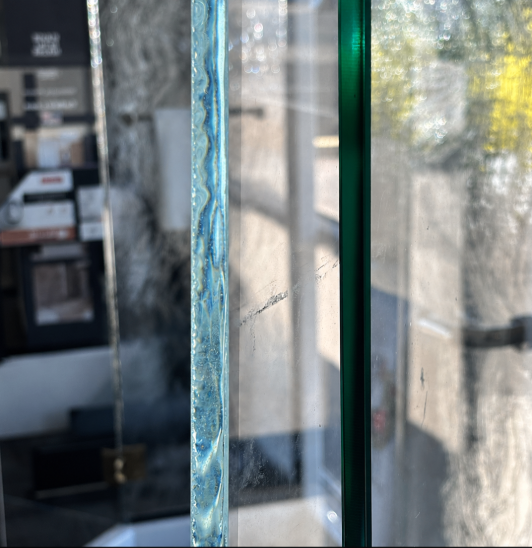
Standard clear tempered glass carries a faint green cast that reads most at the exposed edges and across large panels. Starphire low-iron glass removes that cast, so tile color reads truer.
The upgrade earns its cost in specific situations, not universally. If your tile is white, cream, pale gray, or any cool neutral, the green is visible and low iron is worth the price. If the tile is dark, warm-toned, or heavily patterned, the difference is much harder to see. Look at your own tile in your own light before deciding, which is one more argument for making this call while you are in the house rather than from a thousand miles away in July.
Hinged, Sliding, Pivot, or Fixed
Door configuration is decided more by opening and clearance than by preference.
- Hinged doors swing on wall-mounted frameless shower door hinges and need clearance outside the enclosure. They provide the cleanest look where the room allows.
- Pivot doors rotate on a top and bottom frameless shower door pivot rather than side hinges, which suits certain openings and heavier panels.
- Sliding enclosures run on a top rail and rolling hardware and need no swing clearance, which makes them the answer in tight primary baths and in tub conversions.
- Fixed panels have no moving parts at all. Walk-in frameless shower enclosures built around a single fixed panel, or a panel and return, remove hardware wear from the equation entirely.
Fewer moving parts are a real consideration for a part-year home. Rollers and hinges that go unused for five months are fine, but there is less to adjust when you come back if there is less hardware to begin with.
Measure the swing before you settle on a hinged door. Clearance between the door edge and the vanity is a common reason a layout gets redrawn.
Frameless Shower Door Hardware and Arizona Water
Hardware finish is where local conditions genuinely change the recommendation. ABC Glass offers matte black, brushed nickel, polished chrome, satin brass, and oil-rubbed bronze among other designer finishes.
On Valley hard water, polished finishes tend to show mineral spotting sooner because they show everything. Brushed and matte finishes disguise water marks better between cleanings. That matters more in a home where nobody is wiping the glass down daily for months at a stretch.
Protective glass coatings are available as an upgrade and are worth asking about specifically if the house sits unused for long periods. A coating does the most work exactly when regular cleaning is least likely.
You can browse door styles, glass options, and hardware finishes side by side when you design your shower before the estimate, which makes the conversation with an estimator considerably shorter.
What Happens During Measurement and Frameless Shower Door Installation
Good glass shower door installation is decided before anything is cut.
At the measurement appointment, an installer checks the opening for plumb and level, records actual dimensions of the finished tile and curb, notes where studs and backing sit, and confirms what the walls will carry. Frameless glass is heavier than a framed unit, and whether reinforcement is required is determined here rather than on installation day.
Those numbers go to fabrication. Glass is cut, tempered, and edge-finished for that specific opening, and hardware holes are drilled before tempering, since tempered glass cannot be cut or drilled afterward. That is why a custom enclosure cannot be trimmed on site the way a framed unit can, and why the measurement carries so much weight.
On installation day, panels are set, hardware is anchored, the enclosure is aligned, and joints are sealed. Silicone needs time to cure before the shower gets used, so ask your installer how long to wait. If you are handing the house back to a caretaker after installation, that instruction is worth passing along.
ABC Glass Company has fabricated and installed glass in the Valley since 1972, working out of a shop on Cave Creek Road in Phoenix. The company states on its contact page that it completes more than twenty installations weekly, and on its about page that its installers include many with ten to twenty or more years of experience. Residential work carries a one-year workmanship warranty, and the company is licensed in Arizona under ROC #161673-K65.
Five decades in this market matters to a returning homeowner. A shop that has been measuring Phoenix and Scottsdale bathrooms since 1972 has worked through the full range of Valley housing stock, from mid-century homes in central Phoenix with walls that are anything but plumb to recent custom builds out in Cave Creek and Carefree. Seasonal buyers often land in older properties, and that's where measurement experience shows.
Ready to Get the Bathroom Handled This Season
The seasonal homeowners who have a finished shower before the holidays are usually the ones who started the conversation while boxes were still open.
If you are back in the Valley and the primary bathroom has moved to the top of the list, the productive next step is a measurement conversation rather than more browsing. Bring your timeline and your departure date, because those shape the plan more than any design choice will.
ABC Glass Company has served Phoenix and Scottsdale since 1972, and builds custom frameless shower enclosures from its Phoenix shop. Whether you are replacing a framed enclosure that didn't survive the summer or finishing a bathroom in a home you just bought, the team can walk your space, confirm what the opening will support, and give you a real schedule.
Request a free estimate from ABC Glass Company or call (602) 782-5007 to get your project on the calendar for this season.
The ABC's Of Glass

About the Author – Taylor Ann Hancock
Taylor Ann Hancock is the founder of Glass Mama Marketing and a dedicated advocate for innovation within the glass industry. She stays at the forefront of search engine, AI, and digital marketing trends to ensure the information she publishes is accurate, relevant, and aligned with the latest industry developments. Through ongoing research and collaboration with glass professionals nationwide, Taylor provides trustworthy insights that help readers make informed decisions about glass products, services, and industry best practices.